Replacing an electric shower
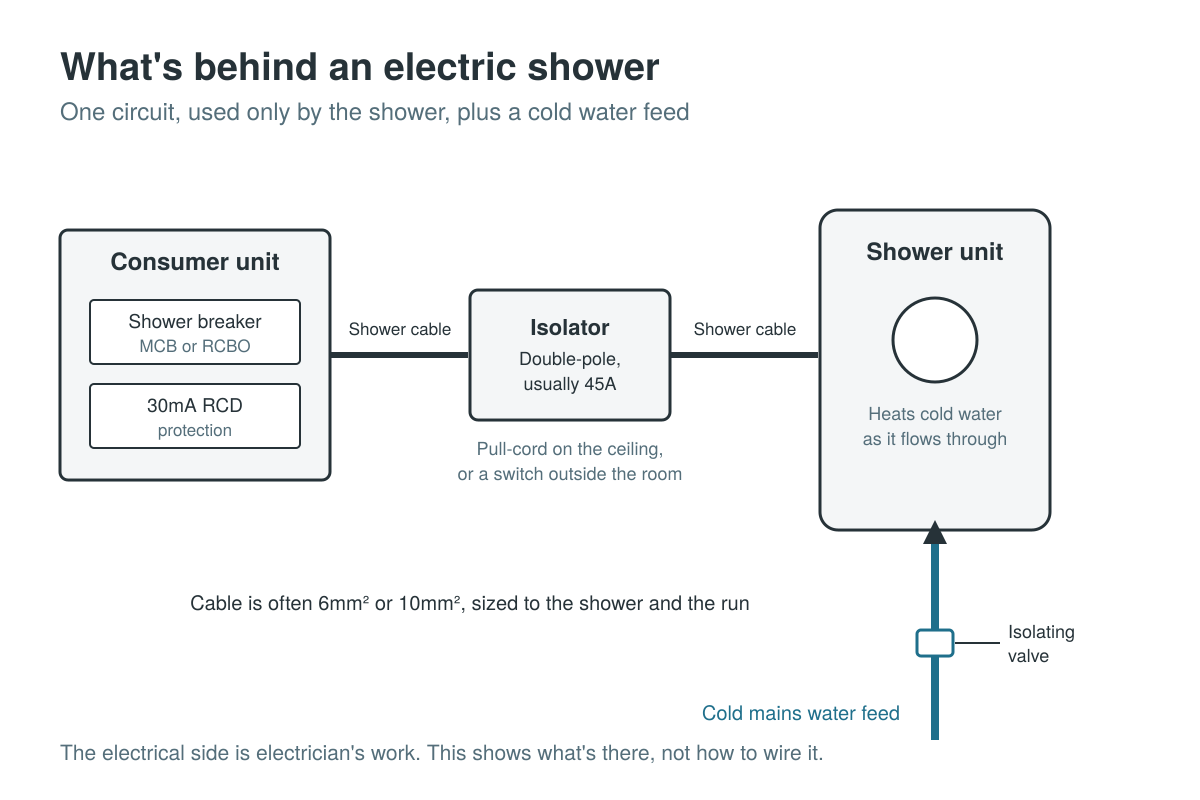
An electric shower heats water as it flows through, and it draws more current than almost anything else in the house. Replacing an electric shower looks like a few screws and three wires, but the cable, the protection and the isolation all have to suit the new unit, in a room full of water.
That makes replacing an electric shower a job for an electrician. Here’s how to tell when it’s time, what the work involves and how to hire well.
Guide · The Honest Fix
Hire a registered electrician for the swap. You can choose the unit and keep it clean.
The short version
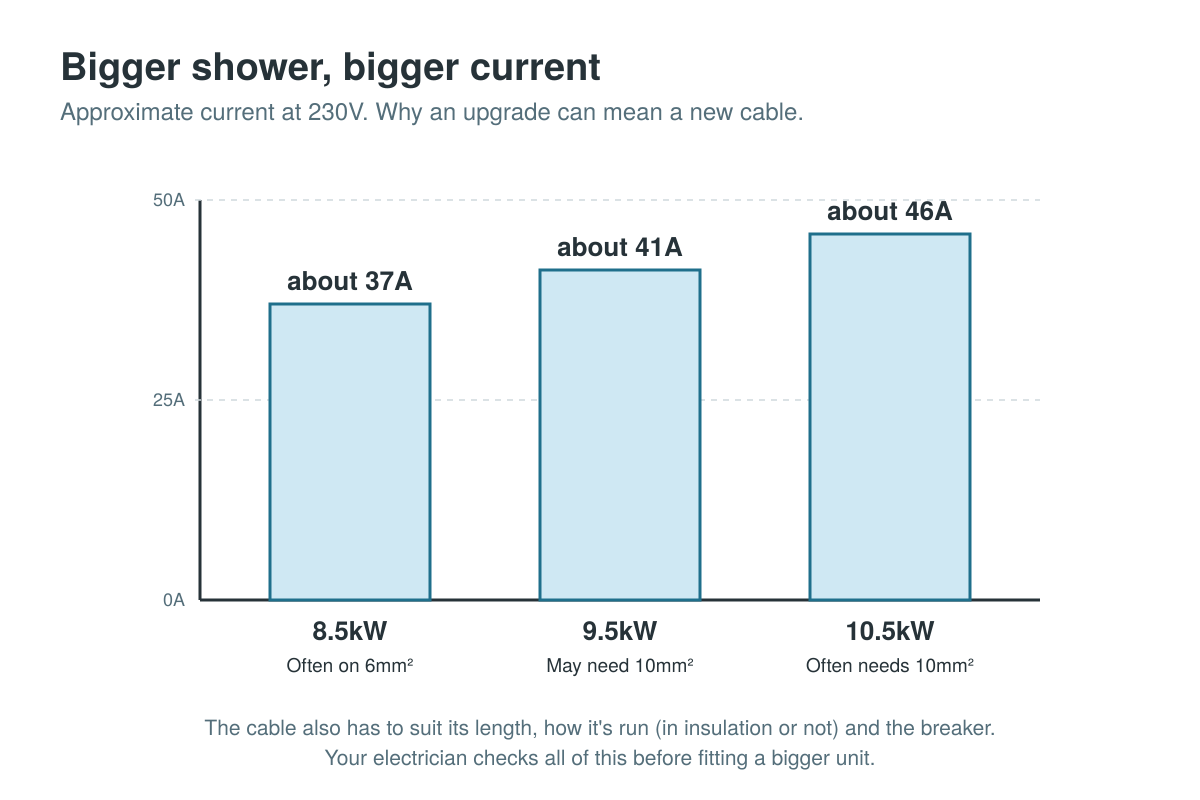
- Electric showers are high-current appliances, often 8.5–10.5kW. That’s about 37–46A on one circuit.
- A like-for-like swap is usually a short job, but the existing cable and protection still need checking.
- A more powerful unit often means a thicker cable, a new breaker or a new circuit.
- Check the electrician’s registration yourself and make sure you get a certificate.
- If you smell burning or see scorch marks, stop using the shower and switch it off at the consumer unit.
What you need for the jobs you can do
- Limescale remover for the shower head, for example HG Bathroom Limescale Remover Foam Spray 500ml, £5.29[2]
- A soft cloth and mild washing-up liquid for the casing
- A replacement hose if yours is worn or kinked, from £7.99[3]
- Your phone, for photos to send with quote requests
- A registered electrician for the swap itself: around £400 supplied and fitted[1]
Signs it’s time to replace it
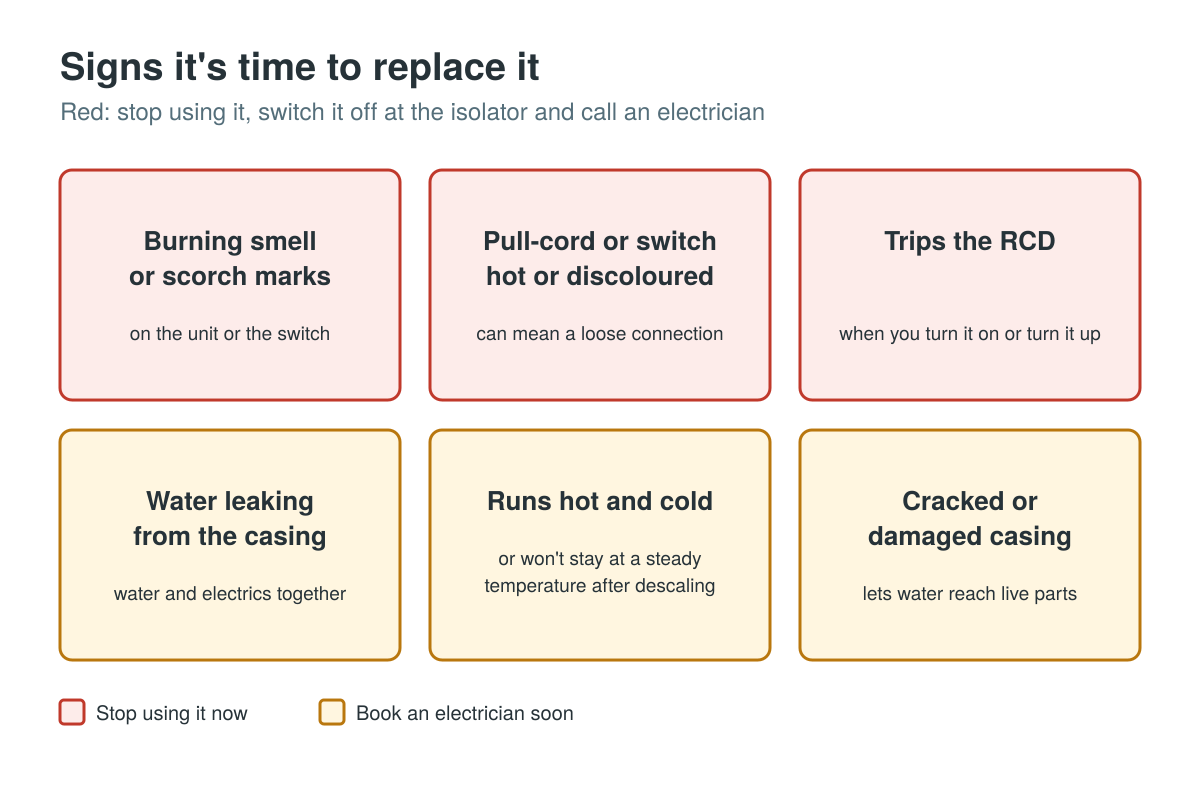
- It runs cold or lukewarm, even on the lowest flow setting.
- It cuts out part-way through a shower, or the flow and temperature keep surging.
- It’s badly scaled up inside, and descaling the head and hose hasn’t helped.
- There’s a burning smell or scorch marks on the case, the isolator or around the cable entry.
- The case leaks, or water is getting in behind it.
- Parts are no longer available for a repair, so replacing the whole unit makes more sense.
Safety
- If you smell burning or see scorch marks, stop using the shower straight away and switch the circuit off at the consumer unit. Leave it off until an electrician has looked at it.
Like-for-like swap or upgrade?
A like-for-like swap means a new unit with the same power rating, on the existing circuit. It’s the simplest version of the job, but “same kW, same cable” still needs checking. The cable may have been undersized from the start, damaged over the years, or run through loft insulation, which makes it run hotter.
Going up in power, say from 8.5kW to 10.5kW, increases the current the cable has to carry. That can mean a thicker cable, a new MCB or RCBO at the consumer unit, a higher-rated isolator, or a new circuit altogether. Many showers up to about 8.5kW run on 6mm² cable, but bigger units, long cable runs or cable buried in insulation often need 10mm². Triton’s guidance gives 10mm² as typical above 8kW.[4] The right size depends on the shower’s kW, the cable length and how it’s installed, so it’s the electrician’s call, not a guess. Find out what your circuit can take before you buy the unit, not after.
If your mains pressure is low, a standard electric shower can be disappointing. A pumped electric shower, fed from a cold water tank, may suit better.
An upgrade can mean new cable all the way back to the consumer unit. Here an electrician rewires three showers:
The rules
Building regulations
- England: In England, installing a new circuit or replacing the consumer unit is notifiable building work, and so is adding to or altering a circuit close to the bath or shower. Simply replacing an existing shower on a suitable circuit is not normally notifiable, but it must still be done safely and to the wiring regulations (BS 7671).[5]
- Wales: Wales has its own version of Part P, and the whole room with a bath or shower counts as a special location. Fitting or replacing an electric shower isn’t notifiable there unless it needs a new circuit[6], but check with your electrician or local building control. A registered electrician can self-certify and will handle it for you.
- Scotland: Scotland doesn’t use Part P. Electrical work in a house of up to two storeys usually doesn’t need a building warrant, but in a flat or taller house a new circuit may need one. The work must meet the building standards either way, so ask your electrician or your council’s building standards team.
Safety requirements
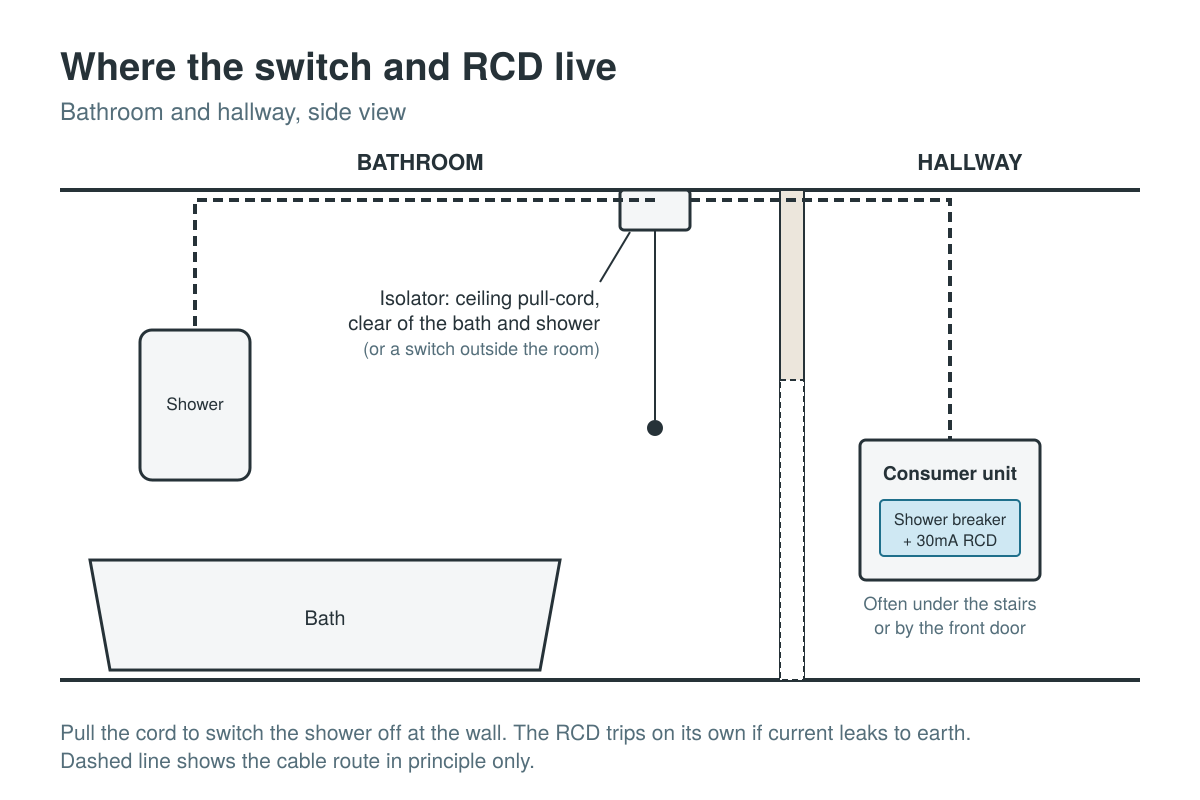
- RCD protection: Under the wiring regulations (BS 7671), bathroom circuits, including the shower circuit, must have 30mA RCD protection.[7] Shower makers say the same.[8]
- Bathroom zones: Electric showers are built to be water-resistant for use in the shower area. The shower needs its own double-pole isolating switch (usually 45A)[9] out of reach of anyone using the bath or shower, normally a ceiling pull-cord in the bathroom or a switch just outside the door.
- Certificate: Expect an Electrical Installation Certificate (EIC) for a new circuit. A swap or alteration on an existing circuit usually gets a Minor Electrical Installation Works Certificate. For notifiable work in England and Wales, you should also get a Building Regulations compliance certificate.[10][11] Keep them, as you’ll need them when you sell.
- Water pressure: Electric showers need decent mains pressure. Triton’s T80Z, for example, needs at least 1 bar and 8 litres a minute, and 1.5 bar and 11 litres a minute for the 10.5kW model.[8] Check the figures for your model.
What a good electrician does
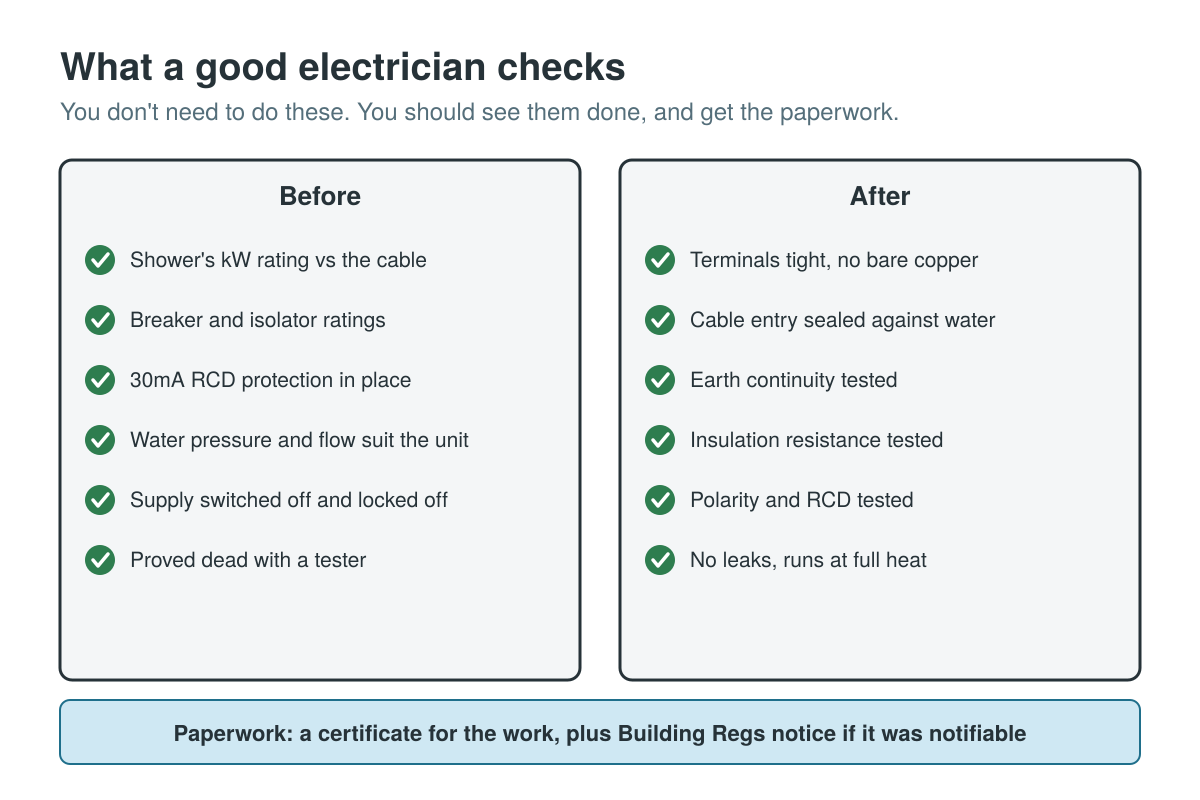
- Tests the existing circuit before fitting anything to it.
- Checks the cable size against the new unit’s kW, and looks at how the cable is run. Cable buried in insulation or walls can carry less current.
- Checks for 30mA RCD protection, and tells you if it needs adding.
- Isolates the circuit at the consumer unit and proves it dead before touching the wiring.
- Seals the cable entry and fits the unit so water can’t get in behind it.
- Tests again after fitting and leaves you the right certificate.
What the job involves, not instructions
We don’t make these videos and aren’t paid to link to them. Turn off the water or power first, whatever a video shows. More video guides
What replacing an electric shower costs and how long it takes
These are rough UK figures, and prices vary by area.
- Time: Most electric shower installations take two to four hours. A straight like-for-like swap is nearer two hours. If a new cable or circuit is needed, allow longer, especially if floors or walls need opening up.[1]
- Like-for-like swap: Checkatrade’s cost guide puts average labour at about £200, and a standard electric shower supplied and fitted at around £400. It gives £150–£300 for the unit itself.[1] Budget units start lower, for example a Triton Riba 8.5kW at £65.69.[12]
- Upgrade with a new circuit or cable: costs more than a straight swap, depending on the cable run and whether floors or walls need lifting. Get a written quote.
- New consumer unit: if yours can’t take a new circuit, replacing it is a separate, bigger job.
Always ask whether a quote includes the unit, the certificate and making good.
How to hire the right person
- Check their registration. Check your electrician on their scheme’s own website (NICEIC or NAPIT, for example), or search the Electrical Competent Person Register, which lists electricians from the government-approved schemes in England and Wales.[13]
- Get a written quote that says what’s included: the unit, any new cable or breaker, the certificate and making good.
- Never pay in full upfront. Paying for the unit in advance can be reasonable. Pay for the labour once the job is done and tested.
- Agree which certificate you’ll get before the work starts.
What you can do yourself
These are the safe jobs. None of them involve taking the cover off the unit. Switch the shower off at the isolator before cleaning it.[14]
- Choose the unit. Ask the electrician what your circuit can take first, then pick the kW rating, a standard or pumped model, and controls that suit everyone in the house. Larger buttons, a clear display and controls at a sensible height help.
- Descale the shower head. Soak it or rub the nozzles with a limescale remover. Redring suggests anything from weekly to quarterly, depending on how hard your water is.[14] Scale reduces the flow and can make the unit overheat and cut out.
- Clean the casing with warm, soapy water and a soft cloth. Makers warn against abrasive or harsh chemical cleaners.[8][9]
- Test the RCD. Press the test button on the RCD in your consumer unit. The current wiring regulations say every six months.[15] It should switch off straight away. If it doesn’t, call an electrician.
- Take photos for quotes. Photograph the shower, the isolator switch and the consumer unit with its labels, so electricians can quote accurately. Don’t open any covers.
- Clear access. Empty the area around the shower, and make sure the electrician can get to the consumer unit easily.
Stop here: call a pro if…
- You smell burning or see scorch marks on the unit, isolator or cable
- The MCB or RCD keeps tripping
- You can’t find the isolator, or it doesn’t switch the shower off
- There’s water inside the unit
- The cable or isolator feels warm
- You’re upgrading to a higher kW unit
- There’s no RCD protection on the circuit
Replacing an electric shower: DIY or hire?
Hire for the electrical swap. Electrical Safety First says an electric shower must be installed by a registered competent electrician, on its own circuit.[16] Even a like-for-like replacement means a high-current connection in a wet room, and the checks that make it safe need test equipment and training.
Fitting a new shower head or hose, descaling and cleaning are fine to do yourself. None of them involve opening the unit.
Common mistakes
- Buying a more powerful unit before checking whether the cable and breaker can take it.
- Assuming the old wiring is right because the old shower worked.
- Fitting a pull-cord or switch that isn’t rated for the shower’s current.
- Leaving the cable entry unsealed, so water gets in.
- Paying for the job without getting a certificate.
FAQs
Can I replace an electric shower myself?
The work still has to meet the wiring regulations, and be tested and certified, even where it isn’t notifiable. In practice, it’s a job for an electrician.
Will a 10.5kW shower work on my existing cable?
Only if the cable size, length and route and the breaker all suit it. Many older showers were wired for lower ratings. An electrician can tell you after a quick check.
Do I need a plumber as well?
Usually not for a like-for-like swap, as most electricians will make the cold water connection. If the pipework needs moving, or you need better pressure, you may need a plumber too.
Why does my shower keep going hot and cold?
Low or changing water pressure, a scaled-up head or the unit’s safety cut-out are the usual causes. If descaling the head doesn’t fix it, get the shower looked at.
References
- Checkatrade, “Shower installation: Cost breakdown 2026”: https://www.checkatrade.com/blog/cost-guides/shower-installation-cost/
- Screwfix, “HG Bathroom Limescale Remover Foam Spray 500ml”: https://www.screwfix.com/p/hg-bathroom-limescale-remover-foam-spray-500ml/132fc
- Screwfix, “Swirl Shower Hose Chrome 10mm x 1.5m”: https://www.screwfix.com/p/swirl-shower-hose-chrome-10mm-x-1-5m/163pg
- Triton Showers, “What cable size does an electric shower need?”: https://www.tritonshowers.co.uk/knowledge-base/what-size-electric-cable-is-required-for-an-electric-shower/
- GOV.UK, “Electrical safety: Approved Document P”: https://www.gov.uk/government/publications/electrical-safety-approved-document-p
- Welsh Government, “Approved Document P: Electrical safety – dwellings (Wales)”: https://www.gov.wales/sites/default/files/publications/2019-05/building-regulations-guidance-part-p-electrical-safety.pdf
- SELECT, “Electrical Installations in Locations Containing a Bath or Shower”: https://select.org.uk/common/uploaded%20files/Technical/FreeDownloads/30269_PG_BathOrShower.pdf
- Triton Showers, “T80Z installation and operating instructions”: https://www.plumbnation.co.uk/documents/triton-t80z-electric-shower-installation-guide.pdf
- Mira Showers, “Mira Sport Installation and User Guide”: https://resources.kohler.com/plumbing/mira/pdf/1493623-w2-a-mira-sport-installation-and-user-guide.pdf
- Electrical Safety First, “Building Regulations for electrical installations”: https://www.electricalsafetyfirst.org.uk/find-an-electrician/building-regulations/england/
- NICEIC (via Voltimum), “Appropriate use of Minor Works Certificates”: https://www.voltimum.co.uk/news/niceic/appropriate-use-minor-works-certificates
- Toolstation, “Triton Riba Electric Shower”: https://www.toolstation.com/triton-riba-electric-shower/p54063
- Registered Competent Person Electrical, “About Us”: https://electricalcompetentperson.co.uk/About-Us
- Redring, “Selectronic Advanced Installation and User Manual”: https://www.showerstoyou.co.uk/uploads/documents/Selectronic_Advanced_Installation_and_User_Manual_V1.1_1.pdf
- IET, “Consumer units and protective devices FAQs”: https://electrical.theiet.org/bs-7671/faqs/consumer-units-and-protective-devices-faqs
- Electrical Safety First, “Electrical Safety Advice for the Bathroom”: https://www.electricalsafetyfirst.org.uk/safety-advice/home-and-people/bathroom/