Wall fixings: how to hang shelves, mirrors, TVs and pictures properly
Most wall fixings that fail don’t fail because the plug was cheap. They fail because the fixing didn’t suit the wall. Getting your wall fixings right comes down to two questions: what’s your wall made of, and how heavy is the thing you’re hanging? If you answer those honestly, a picture, a shelf, a mirror or a TV bracket will stay put for years.
I’ve been on the tools for about twenty years, and these days the fischer DuoLine is what I carry in the van. This guide leans on it heavily because it’s what I trust, not because anyone asked me to. This isn’t sponsored. fischer hasn’t paid for it, seen it or supplied anything for it. Also, every load and drill size below comes from fischer’s own data sheets, linked at the bottom, so you can check them yourself.
Pictures and shelves on a solid wall are easy. Heavy things on hollow walls need care, and some jobs need a pro.
Tools and materials
- A cable, pipe and stud detector (non-negotiable on any wall you don’t know)
- A drill: a combi drill with hammer action does most walls, and an SDS drill makes concrete easy.
- Masonry bits in 6, 8 and 10 mm, plus 10 and 12 mm wood or HSS bits for plasterboard toggles
- A tile or diamond bit (6 or 8 mm) if you’re drilling tiles
- The right fixings for your wall (see the fixing finder below) and screws of the right diameter and length
- Spirit level, tape measure, pencil, screwdriver bits (PZ2, TX), and a vacuum to catch the dust
- Safety glasses and a dust mask
Step 1: work out your wall
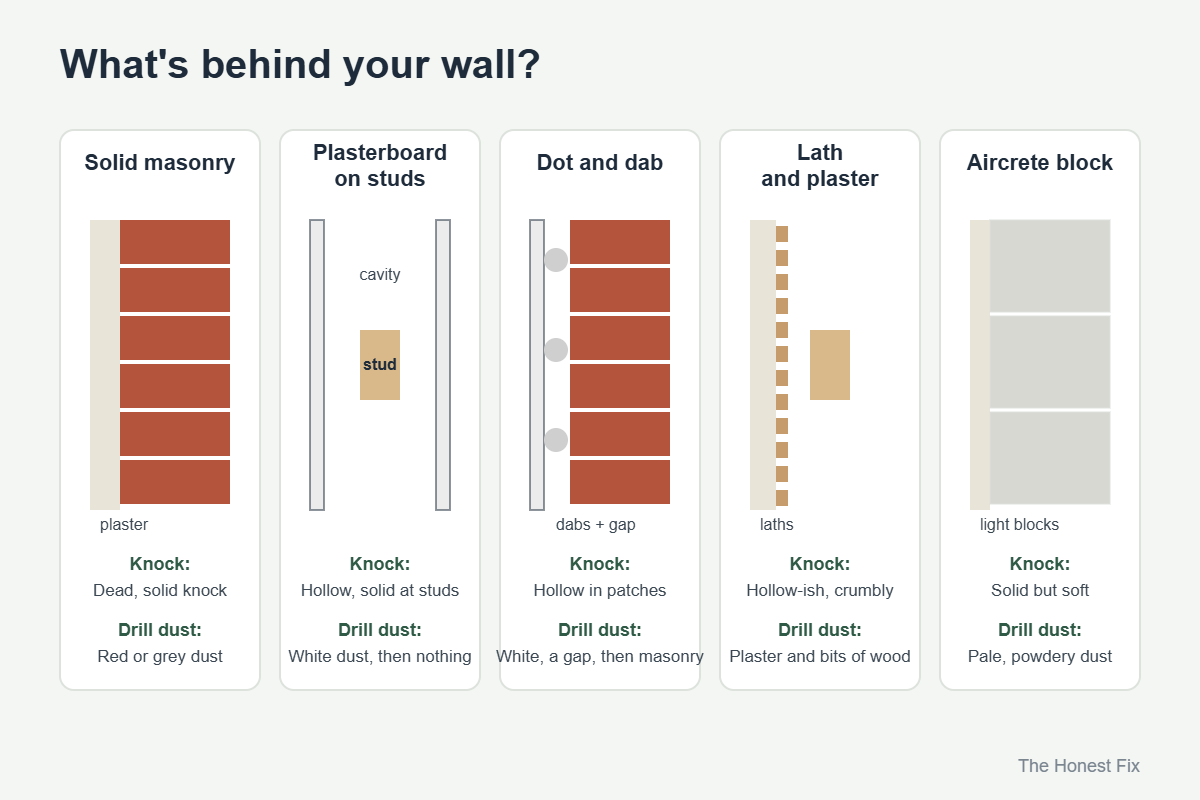
This is the bit people skip, and it’s the bit that matters most. UK homes have five common wall types, and many houses have three or four of them.
The five common wall types
- Solid masonry (brick, concrete block or concrete under plaster). Knock on it and it sounds dead and solid. The drill dust comes out red (brick) or grey (block or concrete). Because it’s so solid, it’s the easiest wall to fix to.
- Aircrete blocks (lightweight “Thermalite”-type blocks, common in newer houses). Solid to knock on, but the drill goes in like it’s cutting cheese and the dust is pale grey and powdery. Plugs hold far less in it, so use long plugs.[1]
- Plasterboard on a stud wall (timber or metal frame with board either side). Sounds hollow, with solid spots where the studs are. The drill breaks through after about 12 mm and the dust is white.
- Dot and dab (plasterboard stuck to a masonry wall with blobs of adhesive). Sounds hollow in patches and solid in others. The drill goes through white dust, then a small gap, then hits masonry. In fact, this catches a lot of people out.
- Lath and plaster (older houses, usually pre-war). Thin timber strips behind thick plaster. It sounds hollow in places, like plasterboard, but the plaster is thicker and crumbles when drilled, and you’ll see bits of wood in the dust.[16] So heavy items on lath and plaster are a job for a pro.
What about tiles?
Tiles sit on top of one of these, so you need to know what’s behind them as well. If you’re not sure, first drill a test hole somewhere hidden and look at the dust.
Finding the studs
On a stud wall, the studs are the strongest thing you can fix to, so it’s worth five minutes finding them. In UK houses they’re usually at 600 mm centres, and sometimes 400 mm, measured centre to centre.[23] Standard timber stud designs also include horizontal noggins between them.[22] So once you’ve found one stud, measure along to find the next.
- Detector: slide it slowly across the wall and mark both edges of each stud. The centre is between the marks. Then go over it again.
- Knock test: hollow board sounds drummy. Over a stud it sounds duller and more solid.
- Clues: screw dimples in the board (shine a torch along the wall), skirting nails and the side of a socket box often line up with a stud.
- Test hole: push a bradawl or a thin bit through where the item will cover it. Timber a few millimetres in means you’ve found the stud. If it drops into nothing, you’re in the void.
Detectors get fooled by foil-backed board, dot-and-dab adhesive and nearby metal. So always confirm with a test hole before you mark the final position.
Metal studs
Newer houses, flats and extensions often have thin steel studs instead of timber.[23] Wood screws won’t grip them. If your test hole hits metal, treat the wall as hollow: move the fixing a few centimetres off the stud and use DuoTec or DuoHM in the board. For anything heavy on a metal-stud wall, though, get a pro.
Check for cables and pipes first, every time
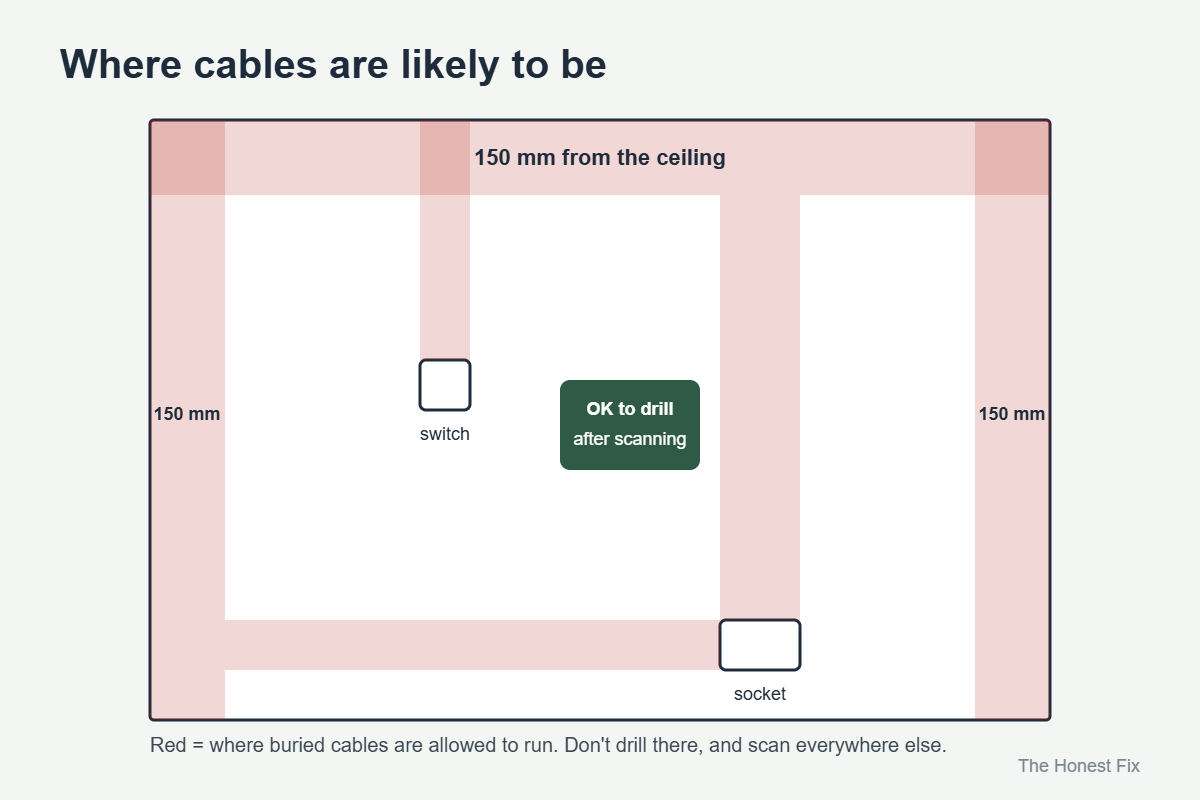
Electricians are supposed to run cables buried in walls within set zones[14]: within 150 mm of the top of the wall, within 150 mm of a corner, and straight up, down or across from a switch or socket.[13][15] On a thin stud wall those zones can apply on both sides of the wall.[15] So treat all of those areas as no-drill zones. But don’t trust them blindly: older and DIY wiring doesn’t always follow the rules, and pipes follow no rules at all. Instead, run a detector over the spot, mark it, then check again before you drill.
Safety first
- Never drill directly above, below or beside a socket or switch, or in a line between two of them.
- Over a window or door there’s usually a lintel. If the bit suddenly stops dead and won’t go in, you’ve probably hit steel. In that case, stop and fix somewhere else.
- Wear safety glasses. Masonry dust and broken tile fragments go straight for your eyes.
- If you drill into a pipe or cable, stop. Turn off the water at the stopcock or the power at the consumer unit, and call a plumber or electrician.
Step 2: match the job to the fixing
First, weigh the item if you can, or check the maker’s spec. Then remember what a shelf full of books or a TV on an arm does: it doesn’t just hang there, it levers the top fixings out of the wall. So always leave plenty of margin.
- Pictures and light mirrors: two light fixings are plenty on almost any wall.
- Heavy mirrors and bathroom cabinets: at least two good fixings, and in a wet area, ones that seal the hole.
- Shelves: the brackets, not the shelf, decide the load. Long brackets also mean more leverage.
- Curtain poles: mostly sideways and downward pull, but people yank curtains. Watch for the lintel above the window.
- Kitchen and bathroom wall cabinets: heavy once full. Use the maker’s hanging rail or brackets, and fix into masonry or studs wherever possible.
- TV brackets: the weight is in the TV specs. Tilt and swing-arm brackets lever the wall much harder than flat ones.
- Radiators: heavy when full of water, and a leak if one comes off. Solid walls or studs only.
All of fischer’s load figures are per fixing, with fischer’s safety factors already built in, and they apply whether the load pulls straight out, straight down or at an angle.[1][2] fischer quotes loads in kilonewtons (kN). 1 kN is roughly 100 kg, and fischer itself converts 0.08 to 0.34 kN as “approx. 8 to 34 kg”.[10] For that reason, I’ve used that conversion below.
Why things that stick out pull harder
Every fixing gets loaded in two ways. Shear is weight pulling straight down the face of the wall, like a picture hanging flat. Pull-out is a force dragging the fixing straight out of the wall. Plasterboard copes far worse with pull-out, because only the board around the fixing is holding it.
Anything that sticks out, such as a shelf, a cupboard or a TV arm, works like a lever. The weight tries to rotate it away from the wall, so the top fixings get pulled outwards. What’s more, the further it sticks out, the harder they’re pulled. fischer’s figures cover any direction of load, but they can’t allow for the length of your bracket. That’s why I size fixings with plenty of spare and use every hole the bracket gives me.
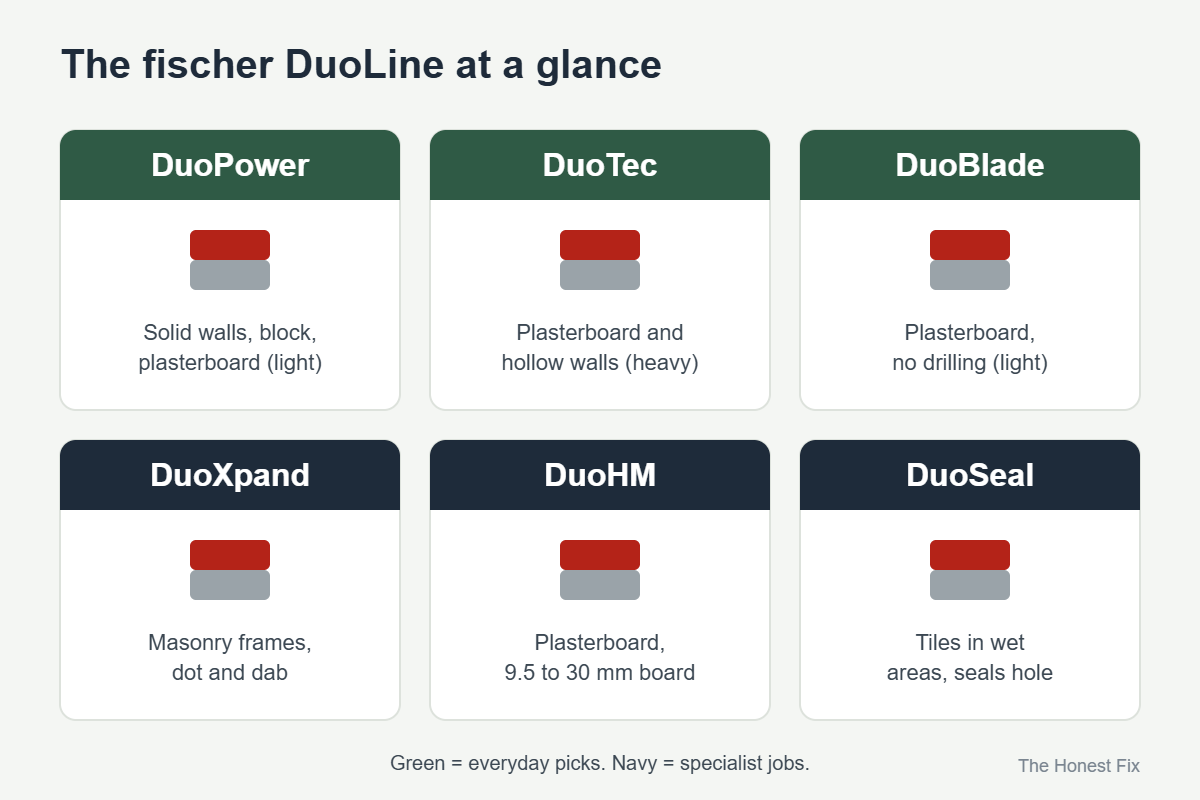
The fischer DuoLine: one fixing for each kind of wall
All the Duo fixings have the same red-and-grey look. The two plastics do different jobs: one is hard and carries the load, the other is softer and grips or seals. So here’s each one, what it’s for and what fischer says it holds.
fischer DuoPower: the everyday plug
If you buy one fixing, buy this. DuoPower expands in solid walls, and folds or knots in hollow ones, so the same plug works in brick, block, concrete and plasterboard.[1] The long versions (6×50, 8×65 and 10×80) are for aircrete, perforated bricks, and reaching through thick plaster.[1]
| Size | Drill bit | Min. hole depth | Concrete | Solid brick | Plasterboard 12.5 mm | Double board |
|---|---|---|---|---|---|---|
| 6×30 | 6 mm | 40 mm | 95 kg | 50 kg | 15 kg | 15 kg |
| 8×40 | 8 mm | 50 mm | 110 kg | 62 kg | 15 kg | 20 kg |
| 10×50 | 10 mm | 70 mm | 215 kg | 120 kg | 15 kg | 30 kg |
| 6×50 long | 6 mm | 60 mm | 165 kg | 55 kg | 15 kg | 24 kg |
| 8×65 long | 8 mm | 75 mm | 230 kg | 69 kg | – | 32 kg |
Recommended load per plug, from fischer’s DuoPower data sheet (03/2023).[1] “Solid brick” is fischer’s test brick; UK bricks vary, so treat that column as a guide. In weak aircrete (the lightest grade fischer tests) the figures drop to about 10 to 30 kg per plug, which is why I always use the long version in aircrete.[1]
Getting the screw right
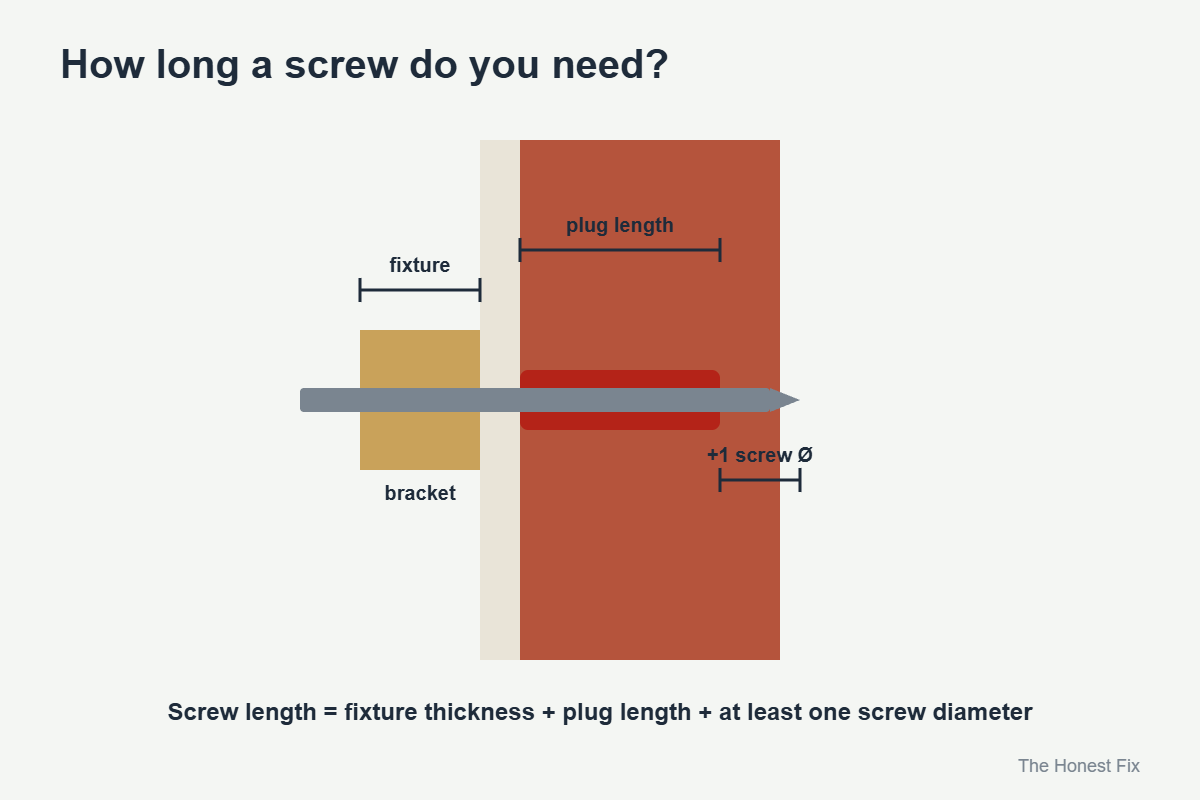
The screw needs to be long enough to go all the way through the plug: plug length, plus the thickness of whatever you’re fixing, plus at least one screw diameter.[1] The diameter also matters: the 6 mm plug takes 4 to 5 mm screws, the 8 mm takes 4.5 to 6 mm, and the 10 mm takes 6 to 8 mm.[11]
Watch it done
Number 1 UK plug: fischer DuoPowerby fischer fixings UK on YouTube (opens in a new tab)What happens when you install a DuoPower into a cavity wall?by fischer fixings UK on YouTube (opens in a new tab)fischer DuoTec: the heavy-duty plasterboard toggle
DuoTec is a toggle. You push it through the hole, it flips upright behind the board, and you slide a sleeve up to lock it in place before putting the screw in. Because the toggle spreads the load across the back of the board, it holds far more than a plug in the board itself. Also, if you hit a stud, it works like an ordinary plug.[2]
- DuoTec 10: 10 mm hole, boards 9.5 to 55 mm thick, at least 40 mm of cavity behind, 4.5 to 5 mm screws.[2]
- DuoTec 12: 12 mm hole, boards 9.5 to 55 mm, at least 50 mm of cavity, 5 to 6 mm or M6 screws. It has a metal insert for higher loads in board and hollow blocks.[2]
DuoTec loads
fischer gives two figures, depending on the span of the board between supports. Using the more cautious figure, a DuoTec 10 or 12 holds about 20 kg in a single 12.5 mm board and about 43 kg in double 12.5 mm board. The higher figures are 36 kg (single) and 59 to 80 kg (double).[2] So I always plan on the lower figure.
Watch it done
How to install a fischer DuoTec fixingby fischer fixings UK on YouTube (opens in a new tab)fischer DuoBlade: quick plasterboard fixings for lighter things
DuoBlade has a metal drill tip, so you screw it straight into plasterboard with a PZ2 bit and no drilling.[20] For example, it’s my choice for smoke alarms, curtain poles, light mirrors and pictures on stud walls. Also, it takes 4 to 5 mm screws.[3]
Loads. About 8 kg in 9.5 mm board, 10 kg in 12.5 mm board, 20 kg in double 12.5 mm board, and 34 kg in 12.5 mm gypsum fibreboard.[3] However, in fibreboard fischer recommends pre-drilling at 8 mm.[3]
Watch it done
How to install a self-drilling plasterboard fixing: DuoBladeby fischer fixings UK on YouTube (opens in a new tab)fischer DuoXpand: frame fixings and dot-and-dab walls
DuoXpand is a long frame fixing that comes with its own screw already in it. You drill straight through what you’re fixing and into the wall, then knock it in and screw it home.[21] fischer says the countersunk version is particularly suited to fixing timber to concrete or masonry.[21] On dot-and-dab walls it reaches through the board and the gap into the solid wall behind, which is why fischer UK uses it for TV brackets on those walls.[4][17][18]
Drill size and loads. 8 mm or 10 mm bits. fischer’s approved figures are about 139 to 179 kg in tension per fixing in concrete, about 43 kg (8 mm) in solid brick (the 10 mm is rated lower, about 26 kg, so use the 8 mm in ordinary brick), and 11 to 14 kg in weak aircrete. In other words, these are “permissible” loads from the fixing’s European approval, so they’re on the cautious side. In masonry, fischer wants single fixings at least 250 mm apart.[4]
fischer DuoHM: the metal cavity anchor, made easier
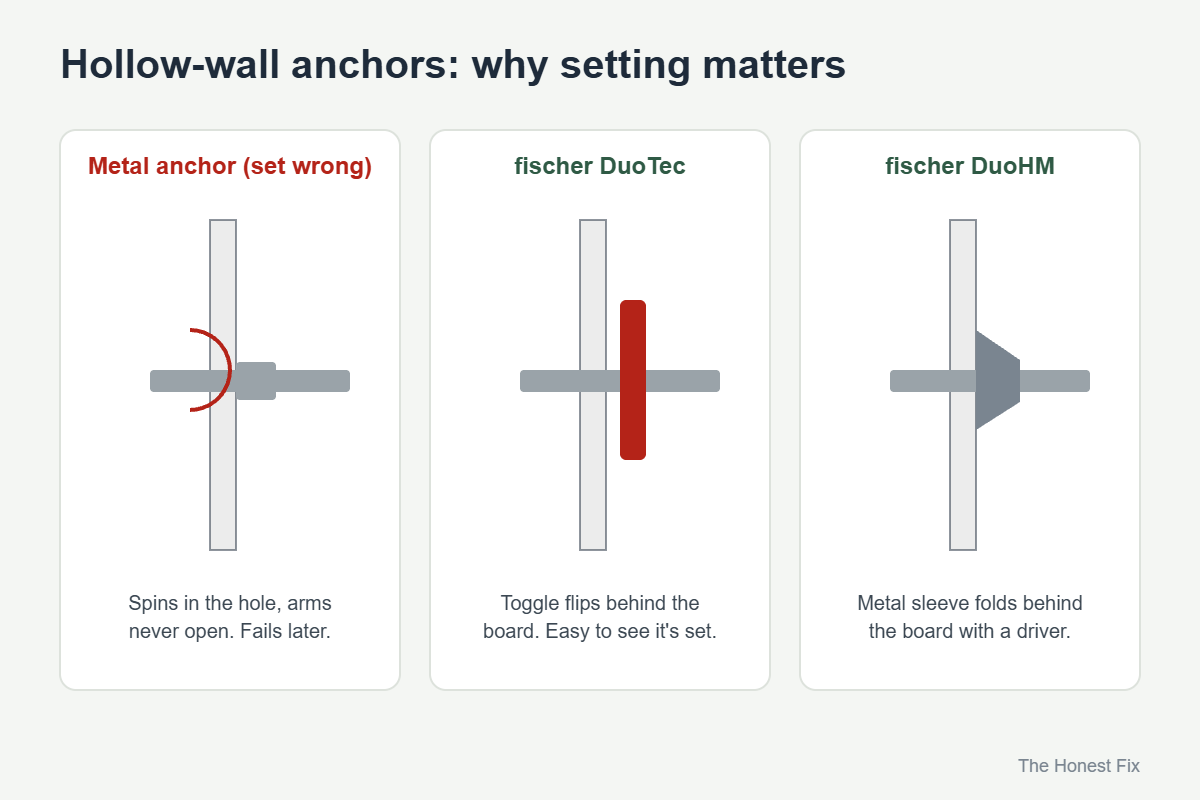
DuoHM is fischer’s take on the metal hollow-wall anchor. A metal sleeve folds up behind the board, the nylon body grips the hole, and you set it with an ordinary cordless driver, with no setting pliers.[5][8] Also, one length covers boards from 9.5 to 30 mm thick. It has a metric thread inside, so you can take the screw out and refit it. It’s done when the metal sleeve is pulled tight against the back of the board and you feel the screw tighten.[5]
Sizes and loads. DuoHM 4×55 needs an 8 mm hole, 5×55 a 10 mm hole and 6×55 a 12 mm hole. Each holds about 15 kg in 9.5 mm board, 20 kg in 12.5 mm board, and 36 to 40 kg in double 12.5 mm board.[5]
Where to buy it. DuoHM is harder to find than the other Duos. Neither Screwfix nor Toolstation listed it when I checked in November 2026, so try a builders’ merchant or an online fixings supplier.
fischer DuoSeal: for tiles in bathrooms and kitchens
DuoSeal is a plug and stainless-steel screw that seal the drill hole as you fix, so water running down the tiles can’t get into the wall behind. As a result, no silicone is needed.[6] fischer has had it tested to the German wet-area standard DIN 18534, up to water-exposure class W3-I (surfaces highly exposed to water).[19] For example, I use it for towel rails, shower baskets and anything screwed through tiles in a wet area.
- DuoSeal 6×38: 6 mm hole, 4.5×60 mm stainless screw. Up to about 40 kg in concrete, 20 kg in solid brick, and 10 kg in single or 15 kg in double moisture-resistant (green) plasterboard.[6]
- DuoSeal 8×48: 8 mm hole, 6×70 mm stainless screw. Up to about 60 kg in concrete, 30 kg in solid brick, and 10 kg in single (only with 8 to 10 mm tiles) or 15 kg in double moisture-resistant (green) plasterboard.[6]
First, drill tiles with a tile or diamond bit, and keep at least 50 mm from the edge of the tile.[7] The figures assume tiles 5 to 10 mm thick, and only apply with the screw supplied.[6]
What about ordinary plastic plugs and spiral anchors?
Basic plastic plugs are made for masonry. In hollow plasterboard they just spin or pull out, so only use them where the plug sits fully in brick or block. DuoPower is different because it knots behind the board, which is why it has a plasterboard column in the table above.
Self-drill spiral anchors (the nylon or zinc ones you screw straight into the board) are fine for light things, and DuoBlade is fischer’s version. Like any spiral anchor, though, it relies only on the board. So keep it to pictures, light mirrors and similar.
The wall fixings finder
Find your item down the side and your wall across the top. Drill bit size is in brackets. If two fixings are listed, the first is my usual choice.
| Item | Solid brick, block or concrete | Plasterboard on studs | Dot and dab | Tiles in a wet area |
|---|---|---|---|---|
| Pictures, light mirrors | DuoPower 6×30 (6 mm) | DuoBlade (no drilling) | DuoPower 6×50 long (6 mm) | DuoSeal 6 (6 mm tile bit) |
| Heavy mirror, bathroom cabinet | DuoPower 8×40 (8 mm) | DuoTec 10 (10 mm) or DuoHM | DuoXpand 8 (8 mm) | DuoSeal 8 (8 mm tile bit) |
| Shelves | DuoPower 8×40 or 10×50 (8 or 10 mm) | Into studs; else DuoTec 12 (12 mm) for light shelves | DuoXpand 8 (8 mm) | DuoSeal 8 (8 mm tile bit) |
| Curtain pole | DuoPower 8×40 (8 mm). Watch for the lintel. | DuoBlade or DuoTec 10 (10 mm) | DuoPower 8×65 long (8 mm) | – |
| Kitchen wall cabinets | DuoPower 10×50 (10 mm) | Into studs or noggins. If you can't, get a pro. | DuoXpand 10 (10 mm) | DuoSeal 8 (8 mm tile bit) |
| TV bracket | DuoPower 10×50 (10 mm) or DuoXpand | Small TV: DuoTec 12 (12 mm). Big TV: studs, or a pro. | DuoXpand 8 or 10 | – |
| Radiator | DuoPower 10×50 (10 mm) | Studs or noggins only. Otherwise get a pro. | DuoXpand 10 (10 mm) | – |
Aircrete? Use the long DuoPower (6×50, 8×65 or 10×80).[1] Drill without hammer action so the hole doesn’t blow out. Lath and plaster? Fix into the studs behind, or get a pro for anything heavy.
An honest word about metal hollow-wall anchors
Metal hollow-wall anchors (often called Molly bolts) and spring toggles are strong fixings, and plenty of good tradespeople swear by them. Set properly, a metal anchor is excellent. However, it’s easy to set one badly, and you won’t know until the shelf comes down.
- Metal anchors need setting properly. fischer’s own metal cavity fixing (HM) is designed to be set with a pair of setting pliers that pull the arms open behind the board.[9] For example, set it with just a screwdriver and the anchor can spin in the hole instead of opening.
- They come in lengths to suit the board. Use one meant for 12.5 mm board in double board and it won’t open properly.
- Overtighten them and they crush the plasterboard.
- Spring toggles need a big hole, and if you ever take the bolt out, the toggle drops into the wall cavity and is gone.
That’s why I use the Duos instead. DuoTec only needs the sleeve slid up and the tab snapped off, and you can see when it’s done.[2] DuoHM is a metal anchor that sets with a normal driver and covers 9.5 to 30 mm boards in one length.[5][8] As a result, both are much harder to get wrong. If you already own metal anchors and the pliers, though, use them. Just set them properly.
No stud where you need one? Noggins and pattresses
When the load is heavy and the studs are in the wrong place, add timber. A noggin is a length of timber fitted between two studs behind the board. However, fitting one means cutting out a section of plasterboard and making good afterwards. A pattress is a board, usually plywood, fixed across two or more studs, either behind the plasterboard or neatly on the surface. As a result, you can screw the bracket anywhere on it.
It’s more work, but it’s the right answer for big TVs on arms, cupboards on stud walls and anything that has to take a knock. Fix the pattress to the studs with wood screws first, and then fix the item to the pattress.
TV brackets and cantilever arms
First, add up the real weight: the TV from its spec sheet, plus the bracket, which can be surprisingly heavy on its own.
- Flat and tilting brackets keep the TV close to the wall, so the load is mostly downwards. On solid walls, DuoPower 10×50 or DuoXpand does the job. On sound plasterboard, a small, light TV can go on DuoTec 12 or DuoHM, well within fischer’s figures.
- Cantilever (swing-arm) brackets are a different job. With the arm pulled out, the TV sits on the end of a lever, and the top fixings get pulled out of the wall with several times the TV’s weight. That’s how arms tear out of plasterboard.
So for any swing arm on a stud wall, fix into studs or a pattress, not the board alone. On dot-and-dab, use DuoXpand to reach the masonry behind, as fischer UK’s own video shows.[18] Also plan the cables. Hiding them in the wall means cutting into the board, and adding a socket behind the TV is electrical work (see the FAQ on building regulations).
Wall cupboards and kitchen units
A wall cupboard is light when it’s empty and very heavy once it’s full of plates, tins and glasses. It also gets pulled on every time a door opens. In short, it’s one of the hardest loads a wall can take.
- Use the hanging rail or brackets that came with the unit.
- On solid walls, use DuoPower 10×50, or DuoXpand 10 on dot-and-dab.
- On stud walls, fix into the studs. Where they don’t line up, screw a timber batten or pattress across several studs first, then fix the rail to that.
- Check the unit sits level and tight to the wall. A gap at the top means the top fixings are taking more pull-out than they should.
For a full run of kitchen units on a stud wall, though, I’d get a pro (see “Stop here” below).
Damaged, soft or patched board
- Soft or crumbling board: if the plasterboard feels soft, crumbles or has been wet, no cavity fixing will hold properly. Instead, find a stud, or replace that section of board first.
- Lots of old holes: a wall full of previous fixings has lost strength there. So move the fixing points, or bridge them with a batten fixed into the studs.
- Lath and plaster: fix into the studs behind, drill gently with the hammer action off, and treat anything heavy as a job for a pro.[16]
How to put up a fixing, step by step
1. Mark and scan
Hold the item up, mark the screw holes in pencil and check them with a level. Then run the detector over each mark, in both directions.
2. Choose the fixing and bit
Use the fixing finder. Check the drill bit size and depth on the pack: the hole needs to be at least as deep as fischer says, or the plug can’t work properly.
3. Drill
Masonry: hammer action on. Aircrete, perforated brick and tiles: hammer action off, and a tile or diamond bit for tiles.[7] Plasterboard: hammer action off, low speed, and stop the moment you’re through. Hold the vacuum nozzle under the hole as you go.
4. Clean the hole
Blow or vacuum the dust out. After all, dust in the hole costs you grip.
5. Fit the fixing
Tap a DuoPower in until it’s flush. Set a DuoTec, DuoHM or DuoBlade as described above. Fit DuoSeal through the tile until the collar sits flush.
6. Fix the item and tighten. Screw through the bracket until it’s firm, then stop. A DuoPower tells you when it’s set: the screw gets noticeably tighter. If it keeps spinning, the hole’s too big or the wall’s too soft. In that case, take it out and rethink.
Stop here: call a pro if…
- You’re hanging a heavy TV, especially on a swing arm, on a stud wall and can’t fix into the studs.
- You don’t know what the wall is made of, or the test hole doesn’t match any of the types above.
- The fixing is above head height: ceilings, high shelves, anything that would hurt someone if it fell.
- The detector shows cables or pipes near the spot and you can’t move the item.
- It’s lath and plaster and the item is heavy, or the plaster sounds loose.
- The plaster is crumbling or the bit keeps wandering, or a fixing keeps spinning however you set it.
- It’s a radiator or a run of kitchen wall cabinets on a stud wall.
Need someone to do it?
In or near Aylesbury? I’m Richard, and I run TradesPro. I can come and sort it for you: tradespro.co.uk or call 07723 966130.
Elsewhere? Use Checkatrade, and take your time. Here’s how to find a good tradesperson on Checkatrade, from someone who’s on it. For gas or electrics, check they have the right registration.
Wall fixings: DIY or get a pro?
Pictures, mirrors, curtain poles and shelves on solid walls are absolutely DIY. As long as you get the right plug and drill bit, you’ll do as good a job as anyone. Moderate weights on plasterboard are also fine with DuoTec or DuoHM, as long as you know what’s behind the board.
Where I’d get help: big TVs on stud walls, radiators, full runs of kitchen units on anything except solid masonry, and anything overhead. That’s because in those jobs the cost of getting it wrong (a smashed TV, a flooded floor, someone getting hurt) is a lot more than an hour of a handyman’s time.
Common mistakes
- Not knowing the wall. For example, a plug that holds in brick will pull out of plasterboard.
- Using the wrong drill bit. After all, an oversized hole means a spinning plug. Match the bit to the plug, every time.
- Hammer action on the wrong wall. It blows out aircrete, perforated brick and tiles.
- A screw that’s too short or too thin. The plug only grips once the screw is all the way through it.
- Ignoring the gap in dot and dab. A short plug just sits in the plasterboard and the gap, so use a long fixing that reaches the masonry.
- Overtightening. In short, firm is enough. More just crushes plasterboard or strips the plug.
- Filling holes in tiles with silicone and hoping. Instead, in a wet area, use a sealing fixing.
FAQs
Can I hang a TV on plasterboard?
A small, light TV on a flat bracket, yes, with DuoTec 12 or DuoHM in sound board and well within fischer’s figures.[2][5] For a big TV or a swing-arm bracket, fix into the studs or get a pro. fischer UK’s own video shows DuoXpand for TVs on dot-and-dab walls.[18]
How much weight can plasterboard hold?
It depends on the fixing, not just the board. In single 12.5 mm board, fischer gives about 10 kg for DuoBlade, 15 kg for DuoPower, and about 20 kg for DuoTec and DuoHM per fixing. Double board holds more: about 20 kg for DuoBlade, 15 to 30 kg for DuoPower, and around 40 kg for DuoTec and DuoHM.[1][2][3][5]
The drill went in, then suddenly dropped. What happened?
You’ve gone through into a gap: either the cavity of a stud wall or the space behind dot and dab. Then look at the dust. White then nothing means a stud wall; white, a gap, then red or grey means dot and dab.
What if I hit a stud?
Good news. DuoPower and DuoTec both work as normal plugs in timber.[1][2] Alternatively, skip the plug and use a wood screw straight into the stud.
Can I reuse an old hole?
Only if it’s the right size for the new plug and the edges are sound. If it’s bigger or crumbly, then move the bracket or go up a plug size.
Do I need a detector?
Yes. It’s the cheapest bit of kit in this guide and the only one that stops you drilling into a cable.
Can I put floating shelves on plasterboard?
Light ones, carefully. A floating shelf has nothing underneath, so all the weight levers the fixings out of the wall. For a loaded shelf, fix the bracket into studs or a pattress, or choose a shelf with visible brackets instead.
Do I need building regulations approval to put up a TV?
Not for the bracket itself. It only becomes regulated if you do electrical work. In England, a new circuit, a new consumer unit or any change to a circuit in a special location such as a bathroom must be notified to building control.[24] Adding a socket to an existing circuit elsewhere isn’t notifiable, but it must still meet the rules.[25] Wales, Scotland and Northern Ireland have their own systems. So for anything electrical, use a registered electrician, who can certify the work for you.
What wall fixings cost
Prices checked on 6 November 2026, including VAT. They change, so check before you buy.
| Fixing | Size and pack | Screwfix | Toolstation |
|---|---|---|---|
| DuoPower | 6×30, 100 pack | £4.99 | £4.79 |
| DuoPower | 8×40, 100 pack | £7.59 | £7.59 |
| DuoPower | 10×50, 50 pack | £8.49 | £8.49 |
| DuoPower long | 6×50, 100 pack | – | £8.19 |
| DuoPower long | 8×65, 50 pack | – | £8.99 |
| DuoTec 10 | 10 pack | £15.99 | – |
| DuoBlade | 20 pack | £12.99 | – |
| DuoXpand countersunk | 8×120, 4 pack | £5.49 | – |
| DuoSeal | 6×38, 50 pack | – | £19.49 |
Sources: Screwfix and Toolstation websites, 6 November 2026.[11][12] Neither listed DuoHM on that date.
References
- DuoPower technical data and recommended loads, fischer brochure (03/2023): https://electrical4less.co.uk/wp-content/uploads/2024/07/VKU_DUOPOWER_EN-1.pdf
- DuoTec technical data and recommended loads, fischer brochure (03/2022): https://electrical4less.co.uk/wp-content/uploads/2024/02/VKU_DUOTEC_EN.pdf
- DuoBlade plasterboard fixing, fischer UK product data: https://www.fischer.co.uk/en-gb/products/cavity-fixings/board-fixing/plasterboard-fixing-duoblade
- DuoXpand load table, fischer (01/2022): https://dapip.inshop.cz/inshop/files/4048962440119/TL_4048962440171_DUOXPAND_FISCHER.pdf
- DuoHM cavity fixing technical data and loads, fischer brochure (01/2024): https://byggecenter.dk/uploads/product_files/20241129132646_VKU_DUOHM_EN.pdf
- DuoSeal technical data and recommended loads, fischer data sheet: https://www.duebel-schrauben-shop.de/bilder/marken/fischer/produkte/content/duoseal-datenblatt_en.pdf
- Installation notes for DuoSeal, fischer (tile or diamond drill, 50 mm from edges): https://res.cloudinary.com/dahlzxcv/image/upload/v1769508771/akeneo-assets/3254227_8203_TT758.pdf
- fischer group, "fischer DuoHM cavity fixing: the latest addition to the fischer DuoLine" (press release, July 2024): https://www.fischer.group/en/newsroom/presseinformationen/fischer-fixing-systems/20240701-duo-hm
- fischer, Metal cavity fixing HM (set with HM-Z 1 pliers): https://www.fischer-international.com/en/products/cavity-fixings/board-fixing/metal-cavity-fixing-hm
- fischer group, "fischer DUOBLADE added to the intelligent fischer DUO-Line" (press release, loads in kN and kg): https://www.fischer.group/en/newsroom/presseinformationen/fischer-fixing-systems/20190116-schneid-f%C3%BCr-gipskartonplatten
Price and safety sources
- Screwfix, search results for "fischer duo" (prices checked 6 November 2026): https://www.screwfix.com/search?search=fischer+duo
- Toolstation, search results for "fischer duo" (prices checked 6 November 2026): https://www.toolstation.com/search?q=fischer%20duo
- Professional Electrician, cable safe zones under BS 7671 (150 mm from top of wall and corners): https://professional-electrician.com/?p=17329
- IET, Change to requirements for RCD protection of cables concealed in walls or partitions (2015): https://electrical.theiet.org/media/1445/cables-in-walls.pdf
- DIY Doctor, Electrical safe zones: running cables through walls and floors: https://www.diydoctor.org.uk/projects/electrical-safe-zones.htm
- DIY Doctor, Fixing to lath and plaster: https://www.diydoctor.org.uk/projects/fixing-to-lathe-and-plaster.htm
- Screwfix, Fischer TX DuoXpand countersunk frame fixings 8mm x 120mm (suits dot and dab walls): https://www.screwfix.com/p/fischer-tx-duoxpand-countersunk-frame-fixings-8mm-x-120mm-10-pack/495hl
- fischer UK, How to install a TV bracket with the fischer DuoXpand dot and dab fixing (YouTube): https://www.youtube.com/watch?v=BcmKiDUH-Ik
- Batipole, "New fischer DuoSeal anchor" (DIN 18534 and ETAG 022 testing, W3-I): https://en.batipole.com/actualites/nouvelle-cheville-duoseal-fischer
- fischer, Plasterboard fixing DuoBlade (self-drilling, PZ2 drive): https://fischer-international.com/en/products/cavity-fixings/board-fixing/plasterboard-fixing-duoblade
- fischer UK, DuoXpand 10 x 120 T R (push-through installation, pre-assembled screw): https://fischer.co.uk/en-gb/products/frame-fixings/frame-fixing-duoxpand/frame-fixing-duoxpand-with-countersunk-head-screw/562165-duoxpand-10-x-120-t-r
- British Gypsum, White Book timber stud partition A046005 (75 x 38 mm studs and noggings, 600 mm centres): https://www.british-gypsum.com/Specification/White-Book-Specification-Selector/timber-frame/timber-stud-partitions/a046005-en
- British Gypsum, partitions selector (stud centres of 600, 400 and 300 mm; metal-framed partitions), published on Contracts Finder: https://www.contractsfinder.service.gov.uk/Notice/Attachment/f83dda99-7183-4924-856a-7926e2113374
- IET, Geoff Cronshaw, Part P third party certification schemes (notifiable work in England): https://electrical.theiet.org/media/1467/part-p_geoff-cronshaw.pdf
- Richmond Council, Building Regulations and electrical works (non-notifiable work): https://www.richmond.gov.uk/building_regulations_and_electrical_works