Electrician or handyman? Who you actually need
Electrician or handyman? People ask me this all the time. “Can you change this light, or do I need a sparky?” Most of the time the answer’s simpler than people think. Some electrical jobs are fine for a decent tradesman, or for you if you know what you’re doing. Some need a registered electrician by law. Here’s where the line actually sits in England.
I’m Richard. I’m a tradesman, not an electrician. So this page is about knowing which side of the line a job falls on, not about how to do electrical work.
Like-for-like swaps are fine for a tradesman. New circuits, a new fuse board or wiring changes near a bath or shower need a registered electrician.
The rule in one line
If you’re replacing something on a circuit you already have, it isn’t notifiable. If you’re adding a new circuit, changing the fuse board, or adding to or altering wiring in the zone around a bath or shower, call a registered electrician.
The government’s guidance puts it like this. Only the work listed in the regulations is notifiable. Everything else is not, “namely additions and alterations to existing installations outside special locations, and replacements, repairs and maintenance anywhere.”[1]
Swapping a light fitting, socket or switch
DIY with careA tradesman can do it
It’s a replacement, so it isn’t notifiable, even in a bathroom. It still has to be done safely and properly.
Adding a socket or light to an existing circuit
DIY with careLegal, but I’d get a pro
Not notifiable outside the bathroom zone. But you’re extending a circuit, and that needs checking and testing properly.
New circuit, new fuse board, or bathroom wiring changes
HIRERegistered electrician
This is notifiable work. Use an electrician on a competent person scheme who can sign it off.
What you, or a tradesman, can do
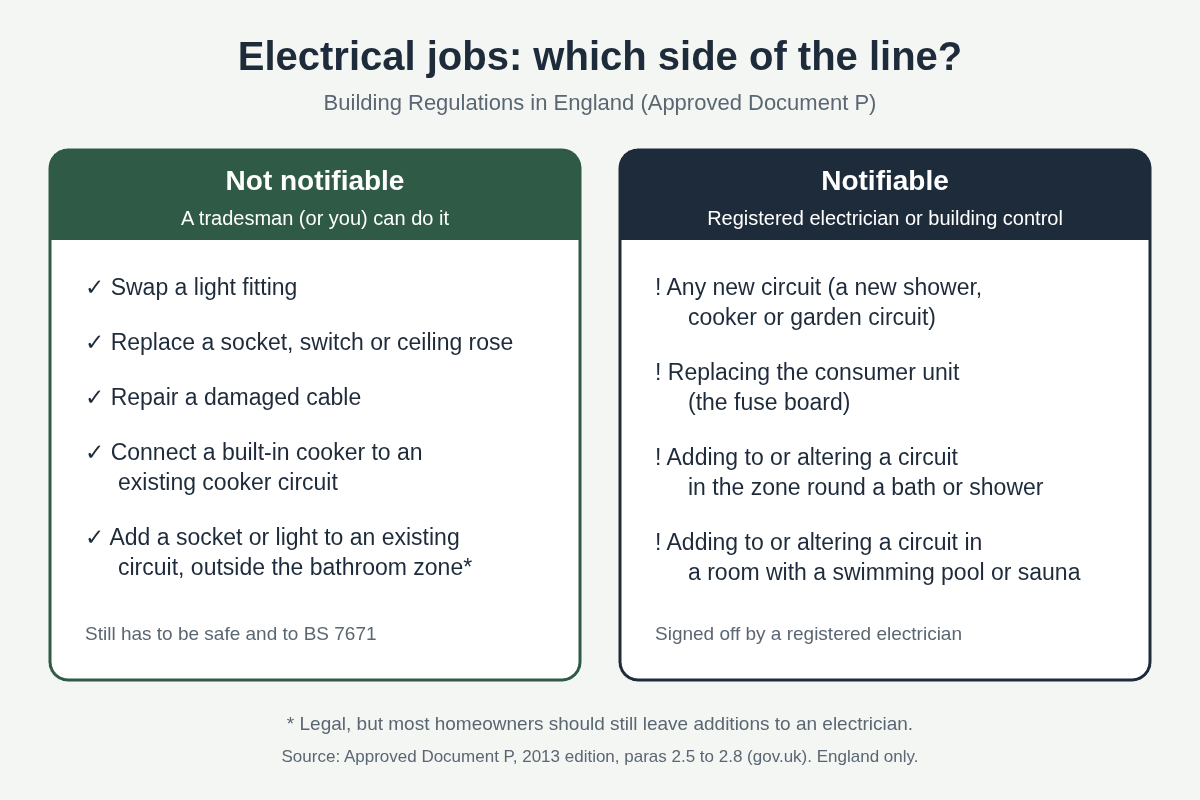
These jobs aren’t notifiable, so they don’t need signing off by building control:[1]
- Swapping a light fitting for a new one in the same place
- Replacing a switch, socket or ceiling rose
- Repairing or replacing a damaged cable on an existing circuit
- Connecting a built-in cooker, as long as no new cooker circuit is needed
- Adding a socket or light to an existing circuit, as long as it’s outside the bathroom zone and not in a room with a pool or sauna. It’s legal, but plainly, most homeowners should still leave this one to an electrician.
Replacements are fine anywhere, bathrooms included. In a bathroom, though, the new fitting has to be suitable for where it’s going, so check before you buy.
The light fittings are the ones I get asked about most. Customers ask me to swap them all the time, and it’s work I’m happy to do.
When you need a registered electrician
These jobs are notifiable:[1]
- Any new circuit, for example for a new electric shower, cooker or garden supply
- Replacing the consumer unit (the fuse board)
- Adding to or altering a circuit in the space around a bath or shower
- Adding to or altering a circuit in a room with a swimming pool or sauna heater
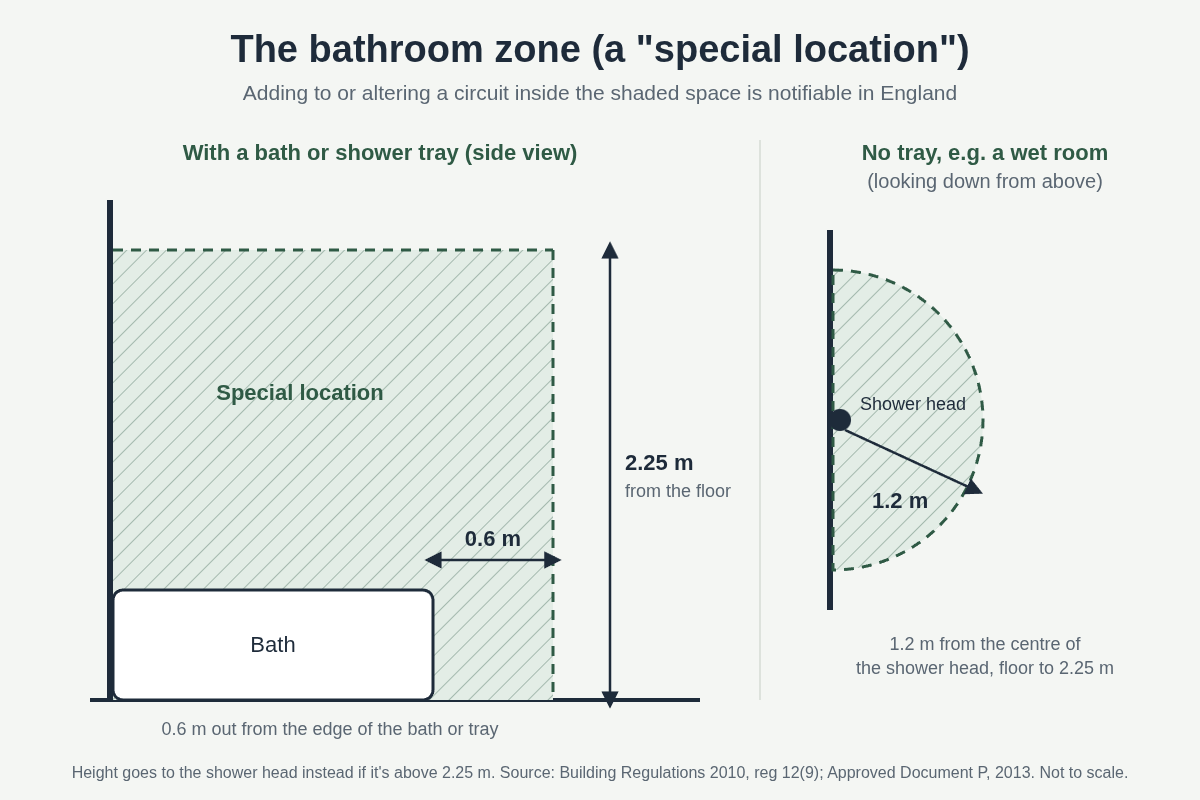
The law calls the bathroom space and pool or sauna rooms “special locations”. In a bathroom, it’s the space within 0.6 m of the edge of the bath or shower tray, from the floor up to 2.25 m. If there’s no tray, as in a wet room, it’s 1.2 m from the centre of the shower head. If the shower head is higher than 2.25 m, the space goes up to the shower head.[2]
How notifiable work gets signed off
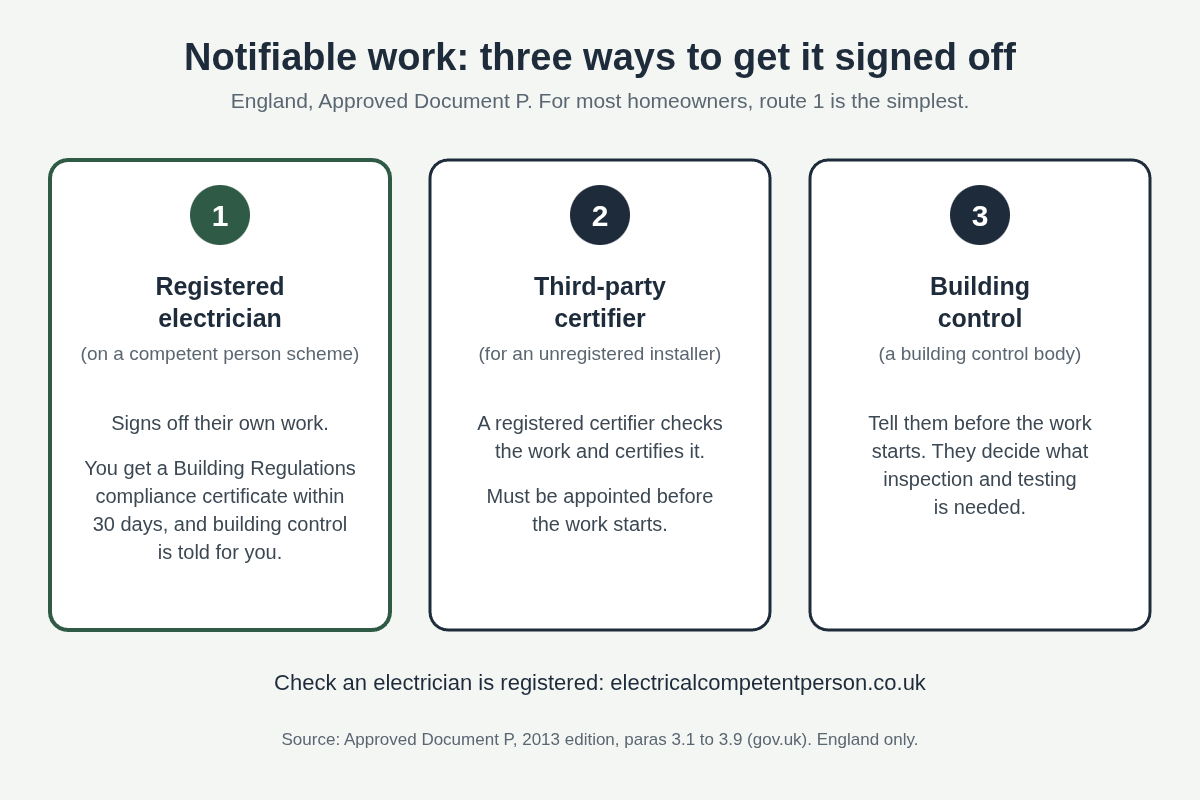
There are three ways:[1]
- A registered electrician on a competent person scheme signs off their own work. Within 30 days you should get a Building Regulations compliance certificate, and building control is told for you.
- A registered third-party certifier can check and certify work done by someone who isn’t registered. They have to be appointed before the work starts.[5]
- Building control. If neither of the above applies, building control has to be told before the work starts. They decide what inspection and testing is needed.
For most people, the first route is the simplest. A registered electrician should also give you an Electrical Installation Certificate, which shows the work was tested.[6]
“Not notifiable” doesn’t mean “no rules”
- This is the bit people miss. All electrical work in a home still has to meet Part P and be done to the wiring regulations, BS 7671.[1]
- Strictly, the guidance says even non-notifiable work should be inspected, tested and certificated to BS 7671. An electrician should give you a Minor Works Certificate for a small job.[1][6]
- If the council finds non-notifiable work that’s unsafe and doesn’t comply, they can take enforcement action.[1]
- Turn the power off at the board and make sure it’s dead before you touch anything. If anything looks odd behind the fitting, stop.
- Drilling into walls for shelves or a TV? Check for cables first. My wall fixings guide covers that.
Kitchens: the myth
You’ll read online that “anything in a kitchen” needs an electrician. In England, that isn’t the rule. Kitchens aren’t a special location. Only the bathroom space and pool or sauna rooms are.[2]
So a new circuit in a kitchen is notifiable, the same as anywhere else. Swapping a light or socket isn’t. The kitchen rule you’ll see quoted is the older one, which Wales still uses (more on that below). England narrowed the list of notifiable work from April 2013.[1][6]
If you’re doing a kitchen refresh and want a new cooker point or extra circuits, that’s electrician work.
What “competent person” actually means
This one caught me out too. You’ll hear electricians talk about being a “competent person”. It sounds like plain English, someone who knows what they’re doing. But in building regulations it means something specific: being registered with a government-authorised competent person scheme. Those electricians can sign off their own notifiable work.[1]
The schemes for electrical work in homes are listed on gov.uk. At the time of writing they are BESCA, Blue Flame Certification, Certsure (trading as NICEIC), NAPIT and OFTEC.[3] Registered electricians are listed on one search site, the electrical competent person register.[4]
So a tradesman with twenty years behind him is competent in the everyday sense. Unless he’s registered with a scheme, though, he’s not a “competent person” in the legal one. If someone tells you they are, it’s fair to ask which scheme they’re with and their membership number, then check it.[6]
Stop here: call a registered electrician if…
- You need a new circuit or a new fuse board.
- You want to add to or change wiring near the bath or shower.
- There’s any sign of damage, burning, scorch marks, buzzing or overheating.
- A trip switch keeps going and you don’t know why.
- You’ve opened it up and something doesn’t look right, or the wiring isn’t what you expected.
- You’re not sure which side of the line the job falls on.
Need someone to do it?
In or near Aylesbury? I’m Richard, and I run TradesPro. I can come and sort it for you: tradespro.co.uk or call 07723 966130.
Elsewhere? Use Checkatrade, and take your time. Here’s how to find a good tradesperson on Checkatrade, from someone who’s on it. For gas or electrics, check they have the right registration.
Electrician or handyman: who to call
A good tradesman for like-for-like swaps: a light fitting, a socket faceplate, a switch, a ceiling rose. Make sure they turn the power off and check it’s dead before they start.
A registered electrician for anything new: a new circuit, a new fuse board, extra sockets, outside lights on a new supply, and anything that changes the wiring in the bathroom zone. Same if something’s already wrong. Finding the fault is the job, and that’s an electrician’s job.
If you’re not sure, ring an electrician and describe the job. A good one will tell you straight if it’s small enough for someone else.
Common mistakes
- Thinking “not notifiable” means “anyone can bodge it”. It still has to be safe and done to BS 7671.
- Believing every kitchen job needs an electrician. In England, only new circuits or a new fuse board do. The old kitchen rule still applies in Wales.
- Taking “I’m a competent person” at face value. Ask which scheme, then check the register.
- Adding sockets with an extension lead mentality. Extending a circuit means it needs checking. If in doubt, get an electrician.
- Forgetting the paperwork. For notifiable work, make sure you get the compliance certificate. Keep it with your house paperwork.
Wales and Scotland
The rules are different. Wales has its own version of Part P. There, adding sockets, lights or other alterations to existing circuits is notifiable in a kitchen, a bathroom or outdoors, as well as new circuits.[6] Scotland has its own building standards system. This page covers England only.
FAQs
Can a handyman change a light fitting?
Yes. Replacing a light fitting isn’t notifiable work in England, so you don’t need a registered electrician. It still has to be done safely and to BS 7671.
Do I need an electrician to add a socket?
Not by law, if it’s on an existing circuit and outside the bathroom zone. But you’re extending a circuit, so I’d use an electrician who’ll test it and give you a certificate.
Is electrical work in a kitchen notifiable?
In England, only if it’s a new circuit or a new consumer unit. Swapping lights or sockets isn’t. Wales is different.
Can I do notifiable electrical work myself?
The rules don’t stop you, but you must tell building control before you start, and they’ll decide what inspection and testing is needed.[1] For most people, a registered electrician is simpler and safer.
How do I check an electrician is registered?
Ask which scheme they belong to and their membership number, then look them up on the electrical competent person register.[4][6]
What does “competent person” mean?
In building regulations, it means an installer registered with a government-authorised competent person scheme, who can sign off their own notifiable work.[1]
References
- Approved Document P: Electrical safety, dwellings, 2013 edition (England), paras 2.1, 2.5 to 2.8, 3.1 to 3.14, Appendix A. GOV.UK: https://www.gov.uk/government/publications/electrical-safety-approved-document-p (PDF: https://assets.publishing.service.gov.uk/media/5a802da7ed915d74e622ceed/BR_PDF_AD_P_2013.pdf)
- The Building Regulations &c. (Amendment) Regulations 2012, definition of “special location” in regulation 12(9). legislation.gov.uk: https://www.legislation.gov.uk/uksi/2012/3119/contents/made
- GOV.UK, “Competent person scheme: current schemes and how schemes are authorised”, electrical installations table (last updated 17 September 2026): https://www.gov.uk/guidance/competent-person-scheme-current-schemes-and-how-schemes-are-authorised
- Electrical competent person register (linked from the GOV.UK schemes page): https://electricalcompetentperson.co.uk/
- GOV.UK, “Third party certification schemes for domestic electrical work” (England): https://www.gov.uk/guidance/third-party-certification-schemes-for-domestic-electrical-work
- GOV.WALES, “Building regulations: electrics” (certificates, checking registration, and the rules in Wales): https://www.gov.wales/building-regulations-electrics